
Throughout the first half of 2026, industrial control systems (ICS) security teams globally have been stretched to their limits. Every update to the US Cybersecurity and Infrastructure Security Agency (CISA) 'Known Exploited Vulnerabilities' (KEV) catalogue triggered a mad scramble to patch critical assets, spiking tensions between IT and OT departments. Yet, as the first half of the year closes, we face an uncomfortable truth: despite soaring patch management budgets, industrial cyber breaches have hit record highs. Why is chasing vulnerabilities failing to protect our infrastructure?
The patch fatigue trap
The CISA KEV list is widely treated as the gospel of cyber defence. Fixing known weaknesses is logical, but the sheer volume has become unmanageable. With the cumulative KEV catalogue surpassing 1,500 entries by mid-2026, enterprises have routinely risked operational downtime just to apply urgent updates to PLCs and HMIs.
In the OT world, uptime is paramount. Frequent patching introduces massive operational risks; testing for software conflicts or system malfunctions can take weeks. This has bred severe patch fatigue among engineers. The real tragedy is that while security teams were buried under this endless cycle of updates, attackers were casually walking through the front door.
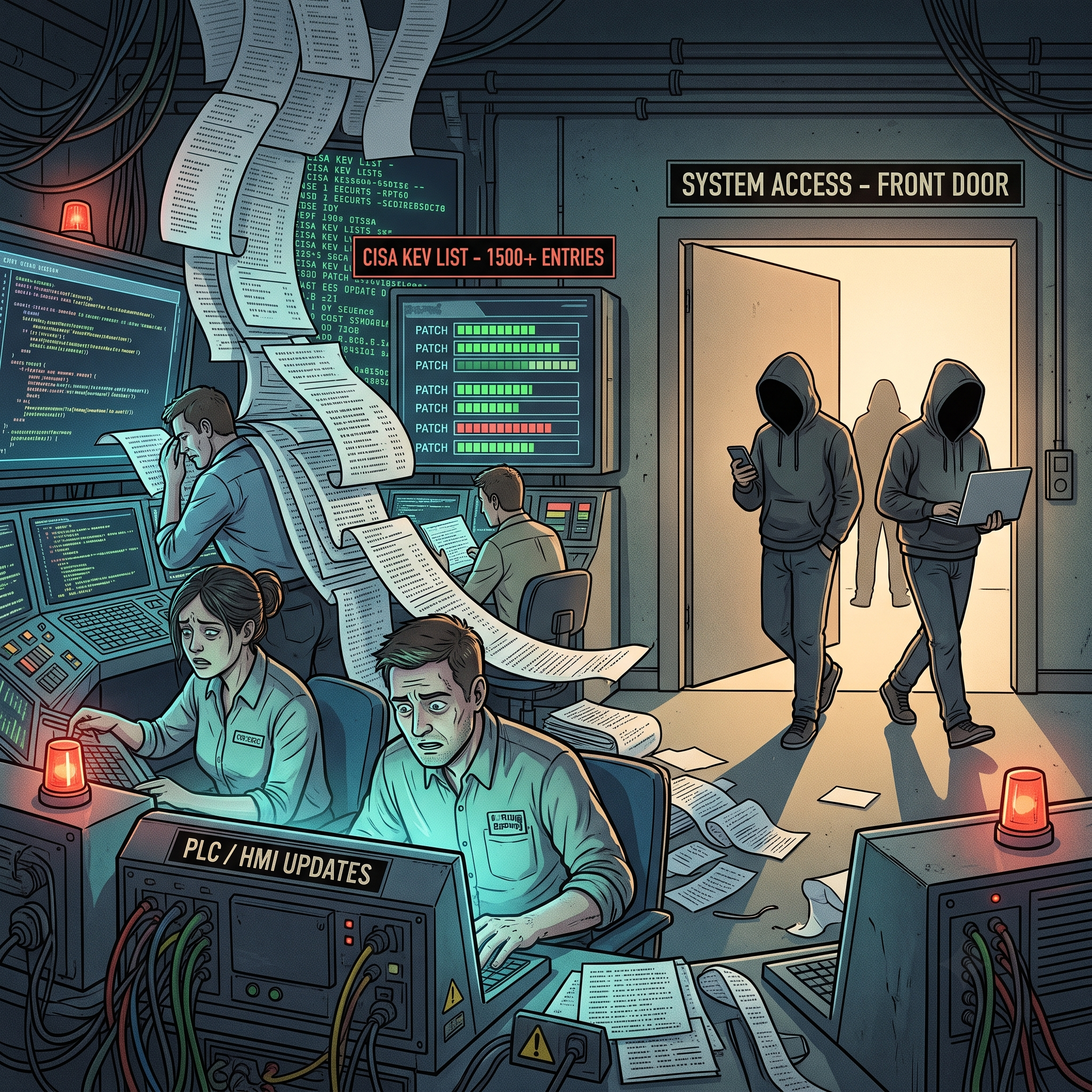
Hackers don't hack; they log in
Threat intelligence from the first half of 2026 reveals a brutal reality: 82% of cyber intrusions detected globally are now completely 'malware-free', relying instead on identity theft and credential abuse. Attackers are no longer burning resources to discover complex zero-day vulnerabilities. Instead, they buy legitimate field engineer credentials on the dark web for a few hundred dollars.
Once a hacker holds valid credentials, even a 'zero-vulnerability' system is utterly defenceless. An HMI cannot reject a destructive command if it comes from a verified administrator account. The intruder isn't forcing entry; they have the master key. This is why a patch-centric defence strategy is fundamentally broken.

Shifting to dynamic identity verification
To survive the remainder of 2026, OT security must pivot from fixing software flaws to permanently neutralising static credentials. Stolen passwords are a systemic risk because they are reusable. However, if the authentication mechanism changes in real time, stolen data instantly becomes useless.
Forward-thinking enterprises are solving this by deploying dynamic authentication architectures. Integrating technologies like the OTAC Trusted Access Gateway (TAG) directly in front of HMIs and engineering workstations is a prime example.
This architecture replaces vulnerable static passwords with mathematically unreplicable, one-time dynamic codes generated at the exact moment of access. Even if a hacker possesses a perfectly valid username and password, they are immediately blocked at the gateway without the real-time dynamic code.
The lesson of H1 2026 is clear: stop chasing endless vulnerabilities and start invalidating the keys. Turning identity into a dynamic asset is the only definitive way to secure physical operations against modern threats.
--------------------

swIDch will continue its quest to innovate and pioneer next-generation authentication solutions. To stay up-to-date with the latest trends sign up to our newsletter and check out our latest solutions.


![[2026 OT Security Outlook for H2] Engineering Workstations Become the Next OT Target](https://www.swidch.com/hubfs/Image%201.%202026%20OT%20Security%20Outlook%20for%20H2.png)