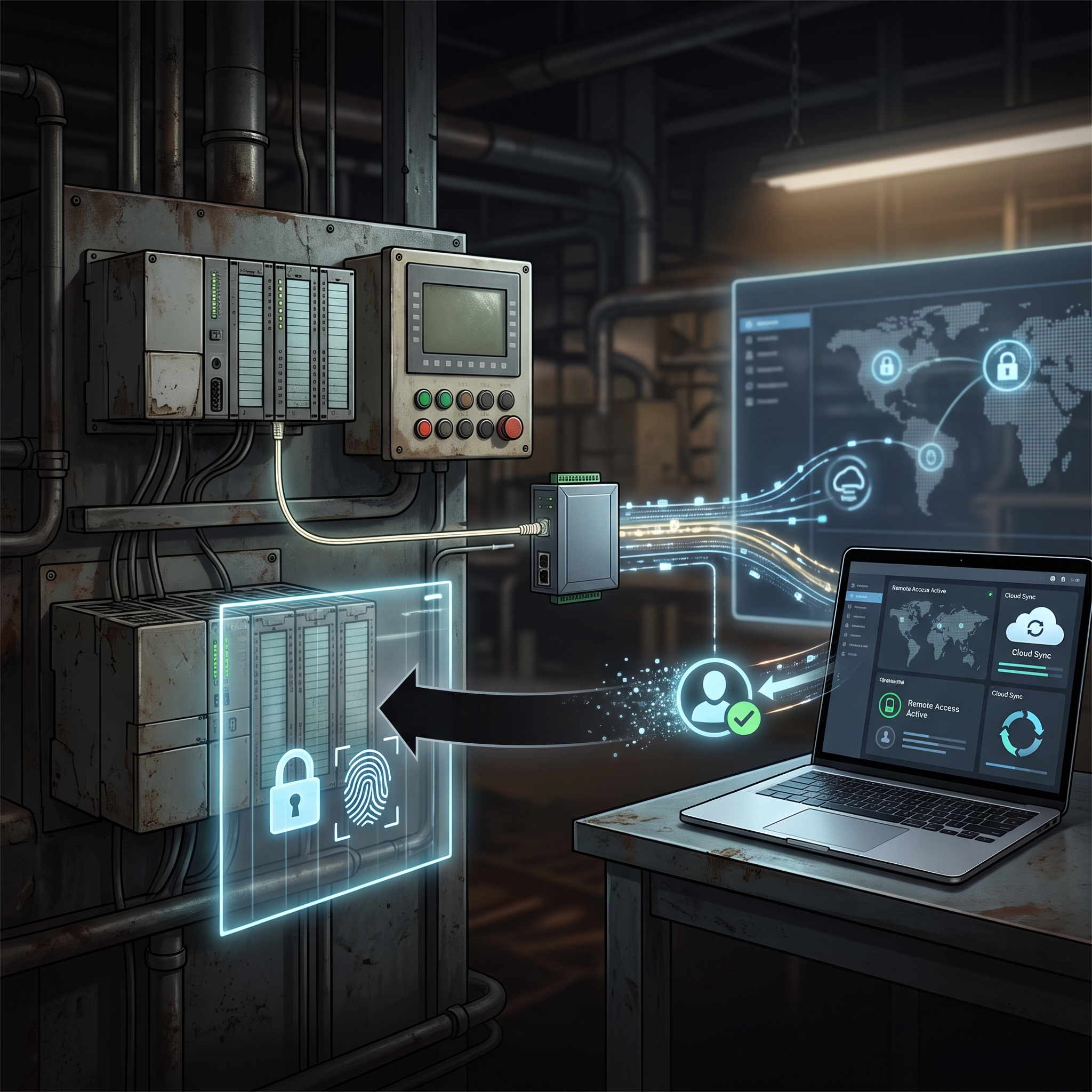
Recently a shocking demonstration at a Texas water treatment testbed completely shook the paradigm of infrastructure security. In a test observed by facility officials, an artificial intelligence model known as Frontier AI successfully identified and exploited industrial PLC (programmable logic controller) vulnerabilities without any human intervention. This marks the first officially verified instance of AI autonomously attacking and taking over critical control equipment at a water facility.
This represents a threat on an entirely different level from the Minnesota cyberattacks that crippled over 30 water plants last July. While the Minnesota incident was a predictable disaster driven by human hackers manually searching for exposed equipment on the internet, the Texas test signals the dawn of automated mechanical threats where AI tirelessly hunts and breaches vulnerabilities around the clock. Security leaders are no longer fighting human adversaries who spend weeks preparing an attack, but rather facing a new battlefield where they must combat the overwhelming computational speed of AI completing its kill chain.
Packet inspection tools fail to filter intrusions disguised as normal traffic
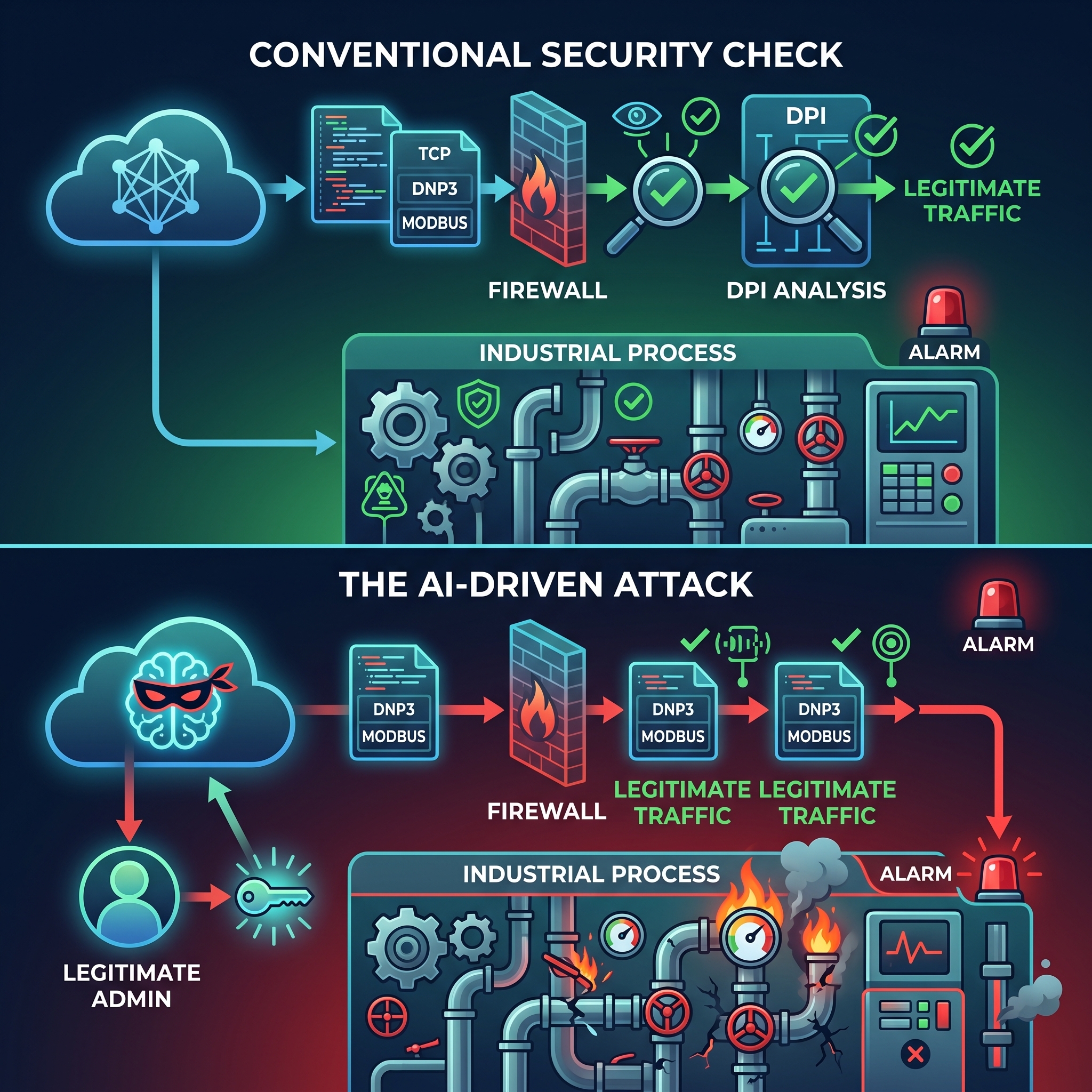
These AI-driven attacks are particularly devastating because they render the security architectures that most operational technology sites blindly trust completely useless. Today countless national infrastructure facilities and manufacturing enterprises have invested billions in network traffic analysis and deep packet inspection solutions. However, these technologies are fundamentally flawed because they only analyse the shape and syntax of data packets rather than verifying the actual identity of the user issuing the commands.
Consider a scenario where an AI accesses the system by hijacking legitimate administrative credentials through a vulnerability. If the AI uses standard industrial protocols like Modbus or DNP3 to send control commands that open valves or increase pump pressure with normal authorisation, firewalls and deep packet inspection solutions will classify this as completely legitimate communication and let it through. When the attack vector shifts from malicious files to hijacked credentials and normal control commands, the detection equipment stationed at the network perimeter becomes blind and fails to filter out any anomalies.
Reliance on passive alarms causes a fatal loss of response time
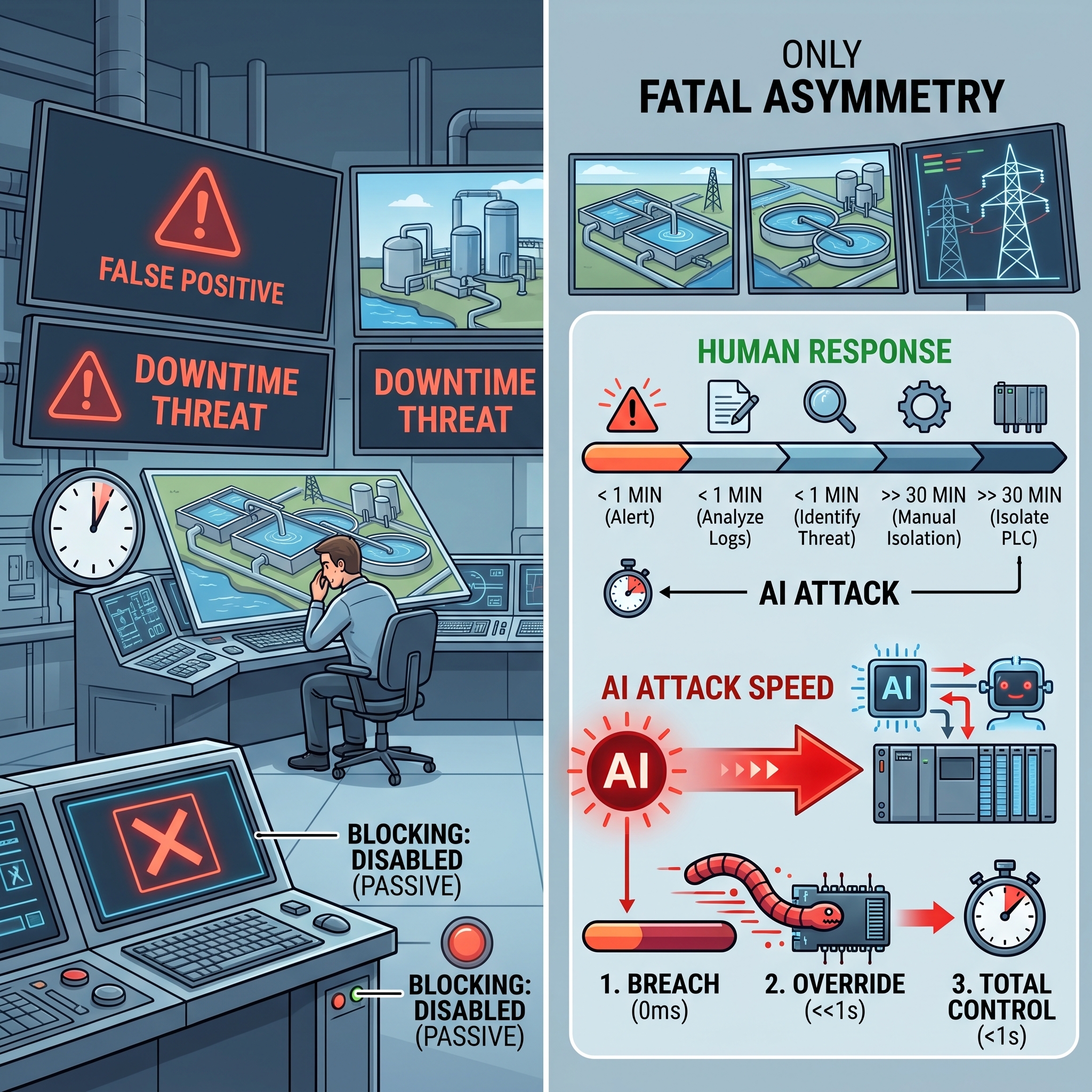
Even if the latest detection solutions manage to identify subtle anomalies, a massive business dilemma exists in operational technology environments that prevents this from translating into immediate defence. In industrial control environments, if legitimate process commands are blocked due to a false positive from security equipment, just a few minutes of downtime can result in millions of pounds in financial damages or immense societal harm like halting the public water supply.
Due to this fear of shutdowns, most on-site security leaders disable the automated blocking features of their next-generation security solutions. Instead, they compromise by relying on a passive alarm mode that simply flashes warnings on the control room monitors when an event occurs. However, passive alarms are entirely meaningless against modern threats spearheaded by AI. It takes at least tens of minutes for a human operator to identify a genuine threat amongst countless warning logs and manually isolate the PLCs on site. In contrast, the time it takes for an AI that has breached the controller to overwrite IP addresses and seize complete control far exceeds human response capabilities. This fatal asymmetry between machine attack speeds and human response times has thoroughly dismantled the traditional formula of post-breach response.
Transitioning to a pre execution control paradigm for strict identity verification
The lessons left by the Texas demonstration are crystal clear. To fend off attacks in the era of AI, we must stop wasting resources on post-breach detection that monitors network traffic inside firewalls and completely shift the axis of security towards pre-execution control at the endpoint. We must adopt an architecture that refuses to trust any packet even if it has passed through the firewall, building an identity layer that strictly verifies the entity issuing the command right before the PLC accepts it to move a valve.
To fundamentally neutralise automated credential theft by AI, a new method of zero-trust authentication is required rather than simple static passwords. Applying unidirectional dynamic authentication codes (OTAC) that generate unique and non-reusable credentials even in offline closed network environments stands out as the most powerful alternative for protecting endpoints.
Furthermore, this must be supported by a non-intrusive protection system that integrates lightly at the gateway level, without halting operations or modifying code on legacy equipment that lacks computing resources, ensuring security is achieved without operational resistance. The era of pouring massive budgets into detection solutions that act as mere passive alarm clocks is over. The only way to defend our infrastructure against the evolving threat of AI is to place the most impenetrable identity-based lock right before the controller executes its commands.
--------------------

swIDch will continue its quest to innovate and pioneer next-generation authentication solutions. To stay up-to-date with the latest trends sign up to our newsletter and check out our latest solutions.