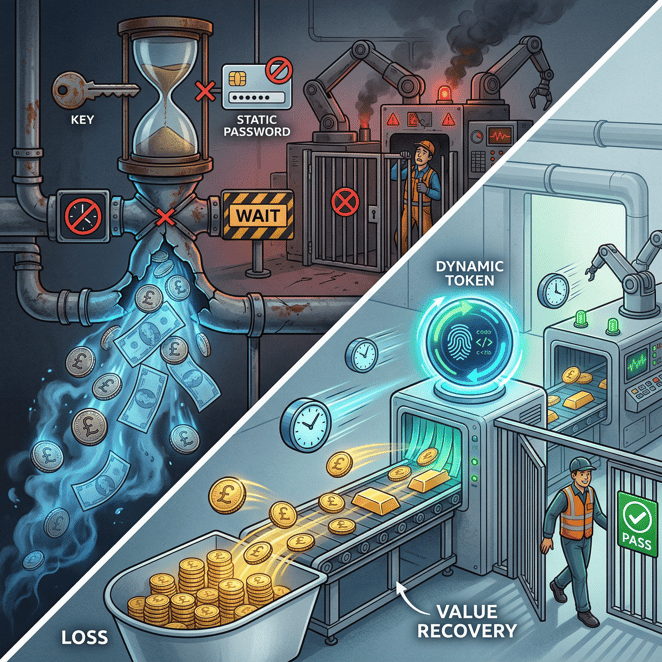
In 2026 downtime in the industrial sector is no longer viewed as a mere operational hurdle but as a direct haemorrhage of corporate cash flow. Recent analysis from the Aberdeen Group suggests that the cost of unplanned downtime for large scale manufacturing organisations now averages $260,000 (approximately £200,000) per hour and this figure continues to climb annually.
For process industries and automated manufacturing facilities where systems are highly inter-dependent the failure of a single point often triggers a domino effect that shuts down entire production lines. In these environments even a conservative estimate based on global benchmarks from ITIC and Siemens places the cost of downtime for a mid sized facility at upwards of £80,000 per hour.
Behind these staggering figures lies a frequently overlooked culprit known as Authentication Friction which acts as a primary bottleneck in the recovery process.
The Mathematical Relationship Between MTTR and Authentication Delays
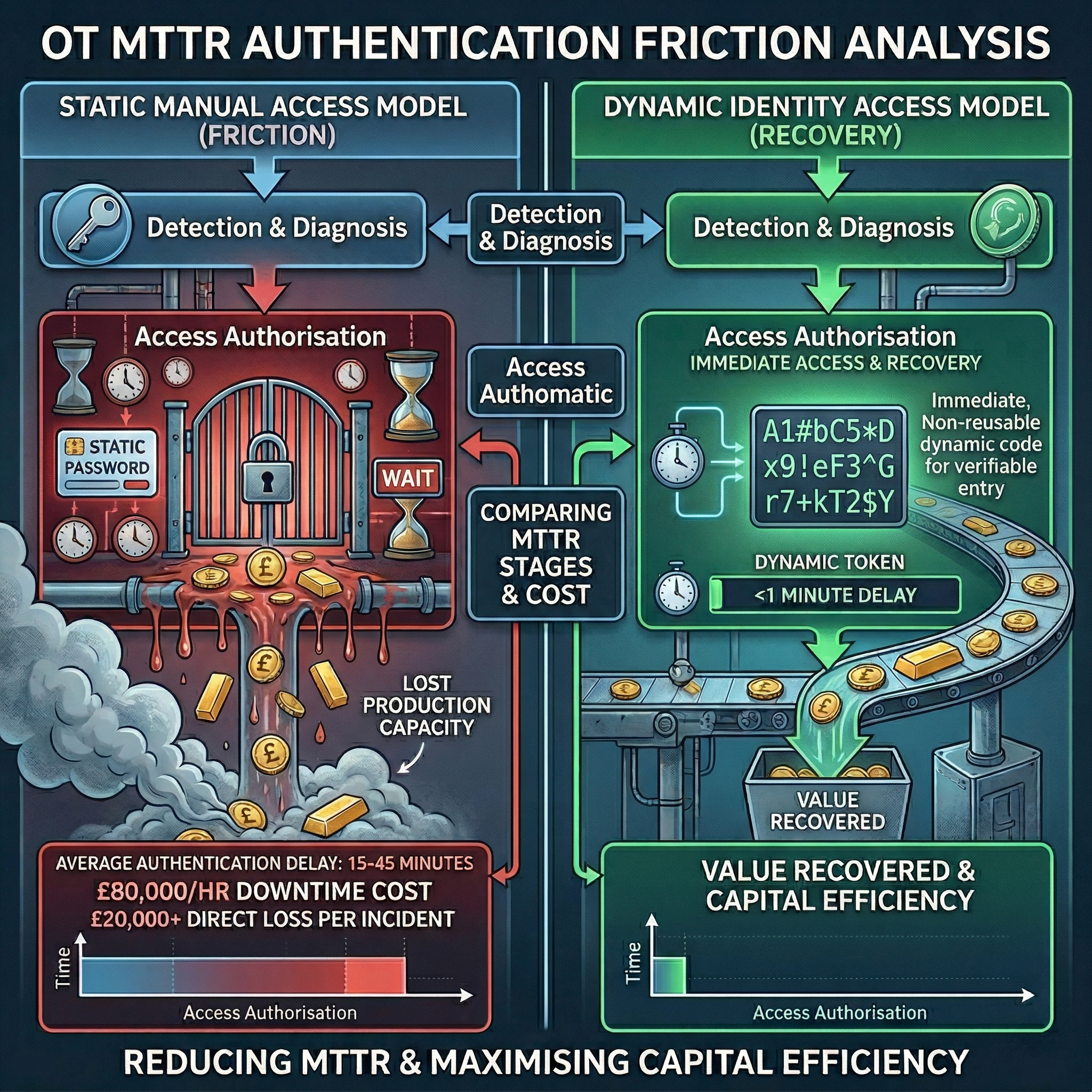
The effectiveness of industrial operations is measured by MTTR (Mean Time To Repair) which spans the stages of detection diagnosis access authorisation repair and restart. The most significant financial leak occurs not during the technical repair itself but during the wait for access authorisation.
- Field Analysis of Industrial Practices: Observations of industrial security workflows indicate that in environments relying on static credentials and manual approval the wait time for external specialists or internal engineers to gain system access averages between 15 and 45 minutes per incident.
- The Financial Impact: Using the conservative downtime cost of £80,000 per hour a mere 15 minute delay in authentication results in a direct loss of £20,000 per instance.
- Cumulative Opportunity Cost: In an enterprise environment experiencing 100 monthly maintenance or emergency access events this friction alone results in the loss of £24,000,000 in potential production value every year.
This is not a theoretical projection but the reality of what Gartner defines as Security Debt where complexity and outdated processes are directly reflected in the cost of goods sold.
Administrative Debt and the Hidden Erosion of Human Capital

The cost of authentication friction extends beyond the immediate loss of production. The inefficiency required to maintain a static credential model represents a significant form of administrative debt.
In 2026 security and operations teams managing large scale OT environments spend approximately 18 to 20 per cent of their weekly bandwidth on manual tasks such as password resets issuing contractor credentials and reconciling logs for compliance audits. This represents a misallocation of high value engineering talent toward basic administrative upkeep which further inflates the Total Cost of Ownership (TCO) for industrial assets.
Recovering Lost Production Capacity Through Authentication Modernisation
The mandate for executive leadership is clear. Transitioning from fixed authentication models to real time dynamic systems is not a simple security upgrade but a vital financial optimisation strategy.
By implementing identity models where credentials are created on demand and expire immediately after use organisations can effectively eliminate the authentication tax that slows down the recovery process. Reducing the MTTR by even 10 per cent through the removal of access friction can improve annual cash flow by millions of pounds. In 2026 OT security investment should no longer be justified by the vague promise of accident prevention but by its ability to recover lost time and maximise capital efficiency.
--------------------

swIDch will continue its quest to innovate and pioneer next-generation authentication solutions. To stay up-to-date with the latest trends sign up to our newsletter and check out our latest solutions.